Which candidates are selected from a finite, discrete set, and under what conditions do they remain stable?
UCL is an interdisciplinary research program exploring this question through mathematics and computational experiments. It examines the structures that can be found, the criteria used to choose among competing candidates, and how those choices and structures hold up as conditions change.
Formal verification and reproducible procedures are central to this work. The aim is to make results verifiable by preserving the findings together with their assumptions, inputs, and methods, so that both the reasoning and the calculations can be traced and checked.
Potential applications of this research include materials design, software verification, production and logistics planning, equipment control, resource allocation, and the analysis of biological networks. Across these fields, some problems can be represented in terms of finite, discrete candidates or states, whose properties can be examined under specified constraints and update rules.
One cross-disciplinary research question is under what conditions fixed points—states that remain unchanged when a specified rule is applied—exist, and what procedures can reach them. By explicitly defining how candidate sets are narrowed or states are updated, and checking the results and the conditions under which they hold, we explore potential applications to search and decision-making.
Our aim is to use this understanding of structure to define the scope of a search and set priorities for verification, supporting decisions about where to allocate limited computing resources, research funding, and personnel.
Details
01 — 06
Six fields form the foundation of the research program.
01
Applied and Discrete Mathematics
Describing structure
Candidate sets and states are represented mathematically to examine their relationships and properties. This provides a foundation for grouping equivalent structures and identifying forms that satisfy specified conditions.
02
Optimization and Model Selection
Defining how to choose
Candidates are compared using criteria such as error, complexity, and the available computational budget. The aim is to make the basis for selection explicit and understand how different criteria affect the outcome.
03
Formal Methods and Mathematical Logic
Checking the reasoning
Formal verification checks whether a conclusion follows from stated definitions and assumptions. The program has used Lean4 to verify steps in mathematical proofs by computer. The scope of these checks is the set of definitions and assumptions used in each proof.
04
Signal Processing and Pattern Recognition
Identifying patterns
Periodic behavior, spectral components, and discrete patterns in data are analyzed to find regularities. This includes examining how reliably patterns can be identified or recovered when noise is introduced.
05
Computational Science and Complex Systems
Exploring changing conditions
Computational experiments vary conditions to examine structural stability and the boundaries at which outcomes change. The focus is on identifying which conditions preserve a result and where a different outcome emerges.
06
Reproducible Research and Scientific Software Engineering
Making results checkable
Inputs, computational procedures, execution environments, and results are recorded so that runs can be repeated and compared under the same conditions. Control experiments help distinguish what has been observed from the claims those observations can support.
Summary
Turning scientific ideas into useful technology.
Universion Closure Logic is a technology company rooted in scientific inquiry. We bring together information theory, artificial intelligence, data science, and communication technologies to develop software, algorithms, and digital products.
At its core is a research perspective: organizing complex problems in terms of candidates, conditions, and rules to consider what to select and where to begin verification. We see potential for research on finite, discrete candidates and states to contribute to fields such as materials design, software verification, production and logistics planning, equipment control, and biological network analysis.
By clarifying the scope of a search and priorities for verification, our aim is to support decisions about where to allocate limited computing resources, time, and funding, and to bring these research insights into practical use as tools and experiences for people and organizations.
Research, development and social implementation in information theory, artificial intelligence, data science and communication technologies.
02
Planning, development, sales, maintenance and technical provision of software, algorithms and related products that utilize research results.
03
Acquisition, management, operation, transfer and licensing of patents, copyrights and other intellectual property rights.
04
Joint research, technical alliances and consulting with companies, universities and research institutes.
05
Human resource development, education, training and outreach activities related to technology.
06
Acquisition and holding of shares in subsidiaries and affiliated companies for investment and management purposes.
07
All other businesses incidental or related to the foregoing.
Products
B2C · macOSReleased
QuotaEcho
A clearer view of your Codex usage.
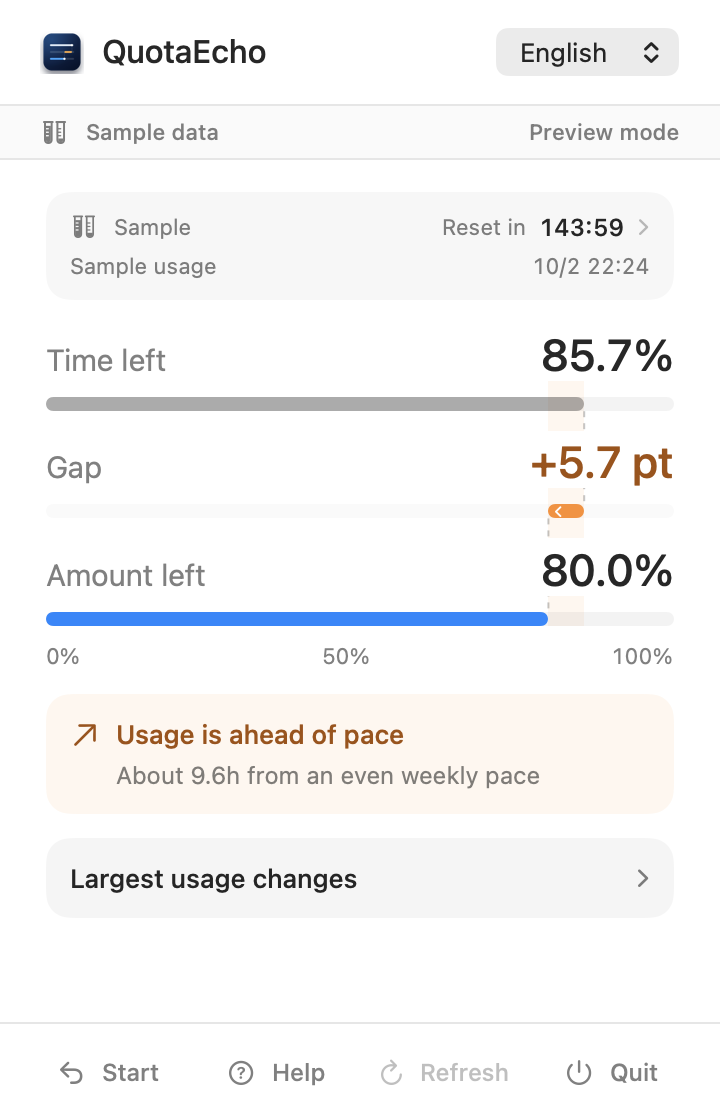
A macOS menu bar app for understanding your Codex usage pace. Compare remaining allowance with time to reset, and revisit the tasks and model settings active during periods of larger usage changes.
A visual discovery app built around choosing between two images. Explore what draws you in, see how your preferences compare with others, and discover how people respond to your own images.
B2B · Materials researchResearch prototype
MGE
Material Governance Engine
A research prototype for screening material candidates and reviewing those outside standard selection rules. It is designed to make selection criteria and decisions traceable, and to organize candidates for further computational or experimental evaluation.
Services
Practical technology for your everyday work.
We help businesses simplify everyday work, build practical digital tools, and turn scattered information into usable data.
01
Workflow & AI Automation
Reduce repetitive work with workflows tailored to your business. We connect existing tools, automate routine tasks, and incorporate AI where it adds value.
We create and improve websites, dashboards, and lightweight applications around your needs—from a service website to a practical tool for everyday operations.
Business websites · Internal tools · Dashboards · App improvements
03
Data Processing & Research
Turn files and public information into organized, usable data. We support web research, data entry, format conversion, cleanup, and reporting, with checks against agreed requirements.
Research lists · Spreadsheet cleanup · Data consolidation · Reports
Every project starts with a clear scope, defined deliverables, and agreed checks.