A proof in the original electronic-band setting, together with finite-mesh evaluation of symmetry-class AI transition signs under the source conventions and admissibility conditions. The paper and HTML verification guide are available on Zenodo.
Three papers and their verification materials are now available on Zenodo: identifying-code density bounds, locating-dominating sets in hexagonal strips, and repair costs for structured observation failures. The research page explains each result and its scope.
UCL has published a preprint on how local observation errors can bound the error of a full quantum state, together with a verification package and an offline HTML guide. Our research page explains the results and their scope.
UCL has posted a preprint establishing Tuza's inequality for a class of graphs with specified triangle-overlap and density conditions. Read the scope and access the paper on our research page.
On 5 November 2026, UCL published five papers and their verification packages on Zenodo. The research page introduces the results on identification and sensor placement in hexagonal strips, king grids, square grids, and the kagome grid.
UCL uses mathematics to study how far limited information can determine an object’s state or properties, and the conclusions that follow. What information is sufficient when we do not know the object in full? Conversely, what loss of information makes determination impossible? Our research focuses on identifying these conditions and boundaries.
For example, can observations of only part of an object guarantee a property of the whole? When two different states produce the same observations, what else must be examined to distinguish them? Through such problems, we study how the amount and combination of available information relate to the conclusions that can be drawn.
We present our results as theorems, with explicit conditions and proofs. When a claim does not hold, we explain why through counterexamples or structural analysis. By working on individual problems, we deepen a mathematical understanding of information and of what can be determined from it, across problems of observation, identification, and verification.
Universion Closure Logic is a technology company rooted in scientific inquiry. We bring together information theory, artificial intelligence, data science, and communication technologies to develop software, algorithms, and digital products.
At its core is a research perspective: organizing complex problems in terms of candidates, conditions, and rules to consider what to select and where to begin verification. We see potential for research on finite, discrete candidates and states to contribute to fields such as materials design, software verification, production and logistics planning, equipment control, and biological network analysis.
By clarifying the scope of a search and priorities for verification, our aim is to support decisions about where to allocate limited computing resources, time, and funding, and to bring these research insights into practical use as tools and experiences for people and organizations.
Research, development and social implementation in information theory, artificial intelligence, data science and communication technologies.
02
Planning, development, sales, maintenance and technical provision of software, algorithms and related products that utilize research results.
03
Acquisition, management, operation, transfer and licensing of patents, copyrights and other intellectual property rights.
04
Joint research, technical alliances and consulting with companies, universities and research institutes.
05
Human resource development, education, training and outreach activities related to technology.
06
Acquisition and holding of shares in subsidiaries and affiliated companies for investment and management purposes.
07
All other businesses incidental or related to the foregoing.
Products
B2C · macOSReleased
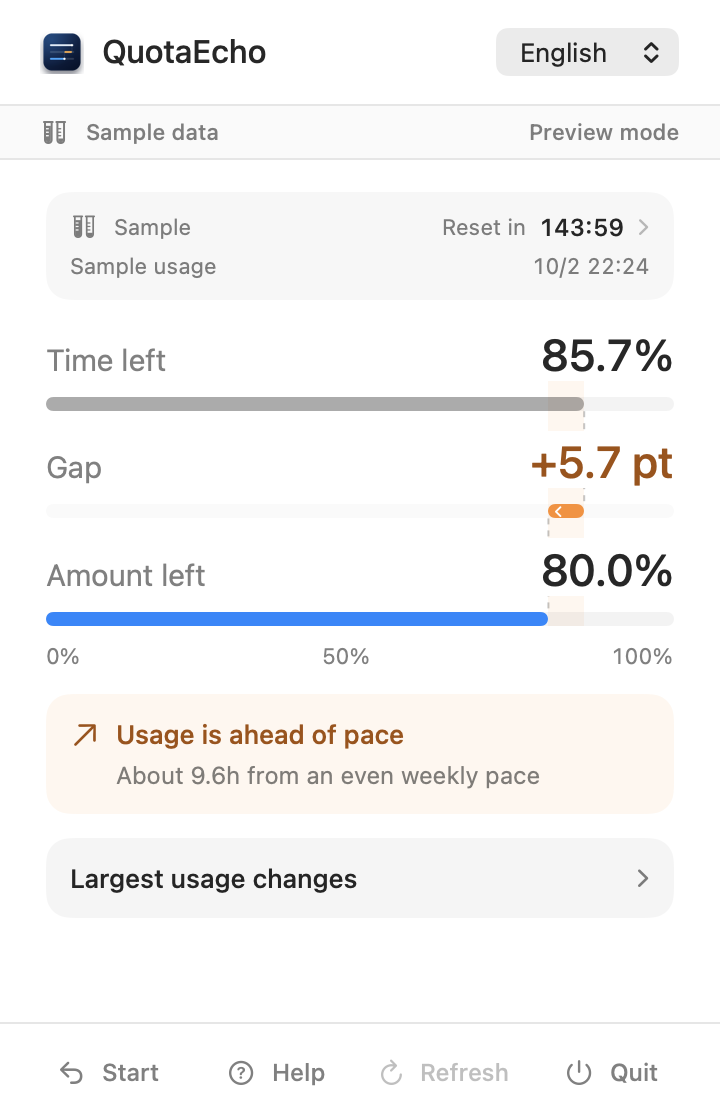
QuotaEcho
A clearer view of your Codex usage.
A macOS menu bar app for understanding your Codex usage pace. Compare remaining allowance with time to reset, and revisit the tasks and model settings active during periods of larger usage changes.
A visual discovery app built around choosing between two images. Explore what draws you in, see how your preferences compare with others, and discover how people respond to your own images.
B2B · Materials researchResearch prototype
MGE
Material Governance Engine
A research prototype for screening material candidates and reviewing those outside standard selection rules. It is designed to make selection criteria and decisions traceable, and to organize candidates for further computational or experimental evaluation.
Services
Practical technology for your everyday work.
We help businesses simplify everyday work, build practical digital tools, and turn scattered information into usable data.
01
Joint Research
We work together on research questions and validation methods, bringing complementary expertise.
02
Joint Development
We define goals and requirements together, collaborating on prototypes, development, and validation.
03
Web & App Development
We create and improve websites, dashboards, and lightweight applications around your needs—from a service website to a practical tool for everyday operations.
Business websites · Internal tools · Dashboards · App improvements
04
Workflow & AI Automation
Reduce repetitive work with workflows tailored to your business. We connect existing tools, automate routine tasks, and incorporate AI where it adds value.
Turn files and public information into organized, usable data. We support web research, data entry, format conversion, cleanup, and reporting, with checks against agreed requirements.
Research lists · Spreadsheet cleanup · Data consolidation · Reports
Every project starts with a clear scope, defined deliverables, and agreed checks.